
Hello and Welcome!
In this online community, we’ll briefly and rapidly explore some key principles of human learning that are informed by cognitive psychology and consider how they can shape course or training design for more durable learning. We will narrow our focus to the following few key principles that explain how learning takes place and influence how knowledge is absorbed and retained:
- Encoding and Consolidation
- Significance of Prior Knowledge
- Desirable Difficulty
- Metacognition
- Cognitive Load
You will have an opportunity to share, with your peers, new ideas you might like to try as well as ways you are already integrating some of these principles into your current teaching or training practices. You will also have an opportunity to share challenges you might currently be facing or anticipate. I invite you to bring generative AI into your reflections if it aligns with your context.
Please note that while some of the content below elaborates on how learners can enhance their study practices, most of our attention will be on course design decisions.
How It Works:
This is a one-week, self-paced, asynchronous course which means you can move through the materials on your own schedule. You will find an ungraded quiz to get started as well as some questions throughout for reflection and sharing. Expect to spend about 2 to 4 hours this week working through the materials.
A follow-on MCTL lunch conversation on what we explore in this mini-course is scheduled for Wednesday, October 29th in Seegers 111. Please join us!
If you have questions related to the content, please feel free to reach out to me directly: Lynn Bello – Lynnbello@muhlenberg.edu. Take your time, explore at your own pace this week, and enjoy the learning experience!
Take the Quiz Below to Get You Thinking About How People Learn
Reflection Question #1
The above quiz was intended to shed light on some common myths about learning that are widely held by both students and teachers.
Which of these myths tend to surface most often in your teaching context and how might you address them through your course design or communication with your students?
Rethinking How We Learn
Let’s begin with a fairly widespread belief that learning, to be effective and long-lasting, should feel smooth, efficient, immediately productive, and even easy. I held this belief for a long time as a learner and remember spending countless hours in college preparing for exams by re-reading the textbook chapters my professors assigned and reviewing my lecture notes over and over. My thinking was that repeated exposure to the course material would burn it into my memory well enough for me to get through my exams. That strategy usually worked in the short term but whenever I tried to recall what I’d learned after the course ended, I often drew a blank.
Nevertheless, this was the primary way I studied in college several years ago. Still today, many learners rely on the same kinds of strategies (re-reading course materials, highlighting, and cramming through rapid-fire, “all-at-once” rehearsal) in an effort to force new information into memory. While these methods may feel efficient and productive in the moment, cognitive psychology research on memory tells us they are not optimal for fostering deep learning that lasts.
The Illusion of Knowing
The sense of familiarity we get from reviewing materials and massed practice (cramming rehearsal of information into one concentrated block of time) can create the illusion we understand new learning better than we really do. Familiarity alone can also give us a false sense that we will be able to recall the information in the future and in multiple contexts or environments. Familiarity is not the same as recall, though. Just because something feels easy to recognize on the page or screen and in a particular study environment doesn’t necessarily mean we understand it on a deep and critical level. Thinking that we do is an example of poor metacognition, something we will talk about a little farther down. I mention it here to underscore that familiarity by itself doesn’t always reveal to us what we don’t know.
Research, on the other hand, shows that learning is more enduring when studying takes place in short sessions spaced out over time, in multiple environments, and when it requires effort through some form of self-testing/recall. To understand why, it is helpful to explore what happens, cognitively, as new information becomes lasting learning. Two key processes, encoding and consolidation, play a central role in this transformation.
Encoding and Consolidation
Learning begins with the sensory information we pay attention to in our environment. As we take this information in, our brains transform our perceptions into mental representations of the patterns and relationships we just realized. This process is called “encoding” and the resulting representations are called “memory traces.” At this stage, memory traces are not fully formed and are easily altered or forgotten.
For example, we may think that our students have fully learned new material immediately following a lively class session that included a combination of lecture, large group discussion, and collaborative meaning-making in small groups. But at this point, students will most likely have formed a kind of loose, fragmented understanding at best, or initial memory traces. Their full understanding won’t start to form until the next stage of the learning process (consolidation). Consolidation involves reorganizing and stabilizing memory traces, making them stronger, and storing them in long-term memory where they can be retrieved at a later time. Consolidation takes place several hours to several days after a learning experience. During this time, it is thought that our minds subconsciously process new information at a deeper level, including while we are sleeping, by rehearsing it to give it meaning, identifying blind spots, and connecting it to what we already know (our prior knowledge).
The Significance of Prior Knowledge
All new learning is built on our prior knowledge. For this reason, activating our learners’ prior knowledge can play an important role in helping them make sense of new learning. The following resource offers some course design ideas for activating and building on learners’ prior knowledge: prior learning resource.
Back to consolidation…
Along with sleep and time, consolidation can be strengthened by course design decisions that draw on what learning scientist Robert Bjork calls the theory of desirable difficulty.
Desirable Difficulty and Learning
The theory of desirable difficulty is somewhat counterintuitive. It refers to learning conditions that can feel effortful, fraught with errors, and even uncomfortable in the moment, yet ultimately lead to stronger and longer-lasting learning. However, when the level of difficulty of a learning activity is too high, the difficulty becomes undesirable and not beneficial to learning. This can happen when the assignment is too confusing, when learners don’t have the background knowledge or scaffolded support they need to complete it, or when they don’t understand the activity’s purpose. A deeper explanation of desirable difficulty, including a brief video recorded by Robert Bjork, can be found here: The Learning Scientist.
One way to introduce desirable difficulty in the classroom is through retrieval practices. Retrieval practices, or practices that pull information out of our minds rather than push information in, can strengthen memory traces and support long-term retention.
Some examples include:
- Frequent, low, or no-stakes quizzes, or polling
- Brain dump activities – Asking learners to write down everything they can recall about a topic or prior class, or any other kind of past learning.
- Think, pair, share
- Elaboration – Asking learners to explain new ideas in their own words and connect them to what they already know.
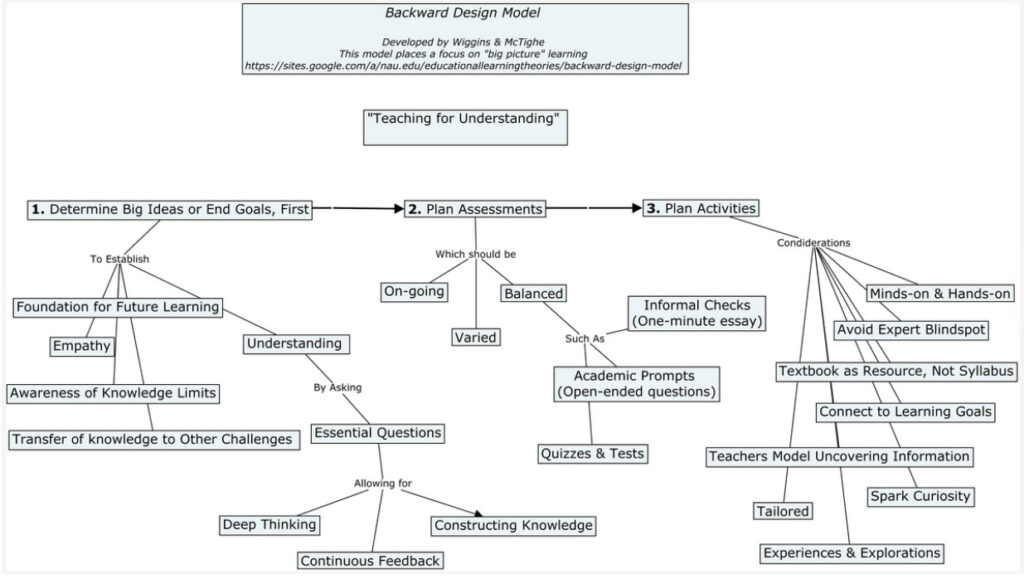
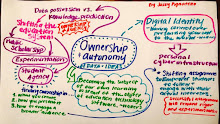
- Concept mapping – Asking learners to visually represent, either digitally or by hand, the relationships between new ideas.
Below is an example of a concept map created with free software:
Below is an example of a concept map that a former media and communication student created by hand. We have her permission to share it and sorry I couldn’t enlarge it without it pixelating:
Retrievalpractice.org is a treasure-trove of additional resources on retrieval practices. This resource, in particular, provides some retrieval prompts that can prevent learners from answering with AI. Additionally, some resources you can share with students about retrieval study practices can be found here: Retrieval study practices.
Interleaving
Interleaving is another strategy for retrieval whereby learners practice multiple types of problems or skills, all mixed together. In contrast to the blocking method, or practicing one type of problem set or skill at a time before moving on to the next, interleaving forces learners to choose a strategy first rather than apply one strategy mechanically in a practice series without much thought as to why. Interleaving is effective when the learning goal is for students to differentiate or discriminate between categories and their elements, like distinguishing between different math problem types, telling apart the works of artists that look similar, or making accurate medical diagnoses.
Interleaved practice is commonly used in the performing arts as well. For example, I sing with a choral arts program and when we rehearse, we never learn any piece of music by starting at the very beginning and working through it sequentially until the very end. Instead, we start somewhere in the middle and jump around to different parts before putting it all together from the beginning. Practicing this way creates a desirable degree of difficulty by forcing us to recall several different parts of the music in single rehearsals. Through this process, which requires great effort, we better learn the challenging transitions in the music, especially.
Reflection Question #2
If you haven’t used retrieval practices in your teaching or student/staff training before, what might you like to try? What challenges do you anticipate?
What are some retrieval practices you have already incorporated into your teaching or training? How did they work out? What kinds of challenges arose for you?
Why Strengthen Memory?
But why design course activities at the college-level that strengthen learners’ ability to recall and produce knowledge like facts, theories and models, processes and procedures, discipline-specific vocabulary, and key principles over time?
Memory and Critical Thinking Are Intertwined
Strengthening the ability to recall and use knowledge over time is important for learning because it makes critical thinking possible. In short, our capacity to think critically is grounded in what we can remember.
Dr. Michelle Miller is a cognitive psychologist and faculty member at the University of Northern Arizona. Her research areas include memory, attention, and how technology affects learning. In the video below, she elaborates on how essential memory is to developing higher-order thinking skills like analysis, problem solving, and creativity. She also makes the argument that building memory remains essential for learning today even though technology increasingly “remembers” for us by storing information that can be quickly and easily retrieved online.
Cues also play a role in what we can remember in the long-term and what we forget. Whenever we take information in, our brains code it along with other conditions, such as our surroundings, our mood, and even whether we are under the influence of a substance. When we take a test under the same conditions that were present while we studied, those familiar cues can trigger recall of information and boost our performance. If the cues change, though, by testing under conditions that are dissimilar to our study conditions, then our ability to recall can be diminished. By varying the conditions under which we study, the dominance of any single cue for recall lessens and this can help us recall information better.
While the external environment can influence how well we learn and remember, our internal cognitive processes (our metacognition) matter just as much.
What is Metacognition?
Metacognition refers to our awareness of our thinking processes and the ability to adjust them to support more effective learning. Good metacognition also results in being accurate in our judgement of what we know and what we don’t know.
Several examples of course design activities that encourage metacogntion can be found here: Metacognition resources.
Reflection Question #3
If you haven’t used metacognitive practices in your teaching or student/staff training before, what might you like to try? What challenges do you anticipate?
What are some metacognitive practices you have already incorporated into your teaching or training? How did they work out? What kinds of challenges arose for you?
Metacognition helps us plan, monitor, and adjust our thinking but this can be difficult when tasks are complex or information is presented in a way that overloads our working memory. Cognitive load theory can help teachers design learning experiences that take their learners’ information processing limitations into account.
Cognitive Load Theory
Cognitive load theory explains how learners process information. There are three types of cognitive load: Intrinsic (the difficulty of the material itself), extrinsic (extraneous distractions or demands), and germane (the productive mental effort that strengthens learning). Cognitive load theory is important to consider when designing learning experiences. The article below explores the theory and its practical application:
Considering Cognitive Load: Refreshing Your Class to Improve Student Learning
Reflection Question #4
Think about a time you explained an idea, shared instructions, or explained a procedure to someone or a group of individuals. How could you tell if they were able to follow you or were becoming overwhelmed? What adjustments helped, or could have helped them better understand what you were communicating?
Final Thoughts
It is increasingly impossible to consider ways of fostering deep learning without acknowledging the impact generative AI is having on how learners approach learning tasks. When learners turn to AI for immediate answers, they often side-step the effortful cognitive processes we explored above that are necessary for building memory, strengthening understanding, and honing critical thinking skills. Generative AI does not change the way people learn, but does change the learning landscape. With that in mind, the final reflection question below invites you to consider how AI could be integrated into a learning activity in a way that maintains cognitive challenge and encourages meaningful engagement:
Reflection Question #5
How might you redesign one of your course assignments or training activities to make intentional use of AI in a way that is transparent and encourages desirable struggle for learning beyond the surface?
How might you invite students to reflect on how they used AI in completing the assignment, what they learned from it, and what they might do differently next time?
Thank You
Thank you for taking part in this brief learning community. I hope you come away with some new ideas for designing learning experiences that encourage the principles we explored rapidly above, for effective learning.
If you’d like to explore these ideas further or collaborate on applying them to your own teaching and learning context, I welcome the opportunity to work with you individually. Please feel free to reach out any time.